Choosing the Right Standard-form Construction Contract: CCDC 2, CCDC3, CCDC4, CCDC5A, CCDC5B and CCDC14
Selecting the appropriate standard-form construction contract is one of the most important decisions made at the outset of a project. Ideally, the appropriate contract structure should be considered and selected as early as possible during a project’s lifecycle.The form of contract determines much more than how the contractor will be paid. It establishes who carries design risk, who contracts with the trades, how much cost certainty is available before construction begins, how changes are managed, and how much project administration remains with the owner. It is also of key importance to consider how each of these standard-form CCDC and CCA agreements impacts counterparty and liability risks throughout a project’s lifetime.
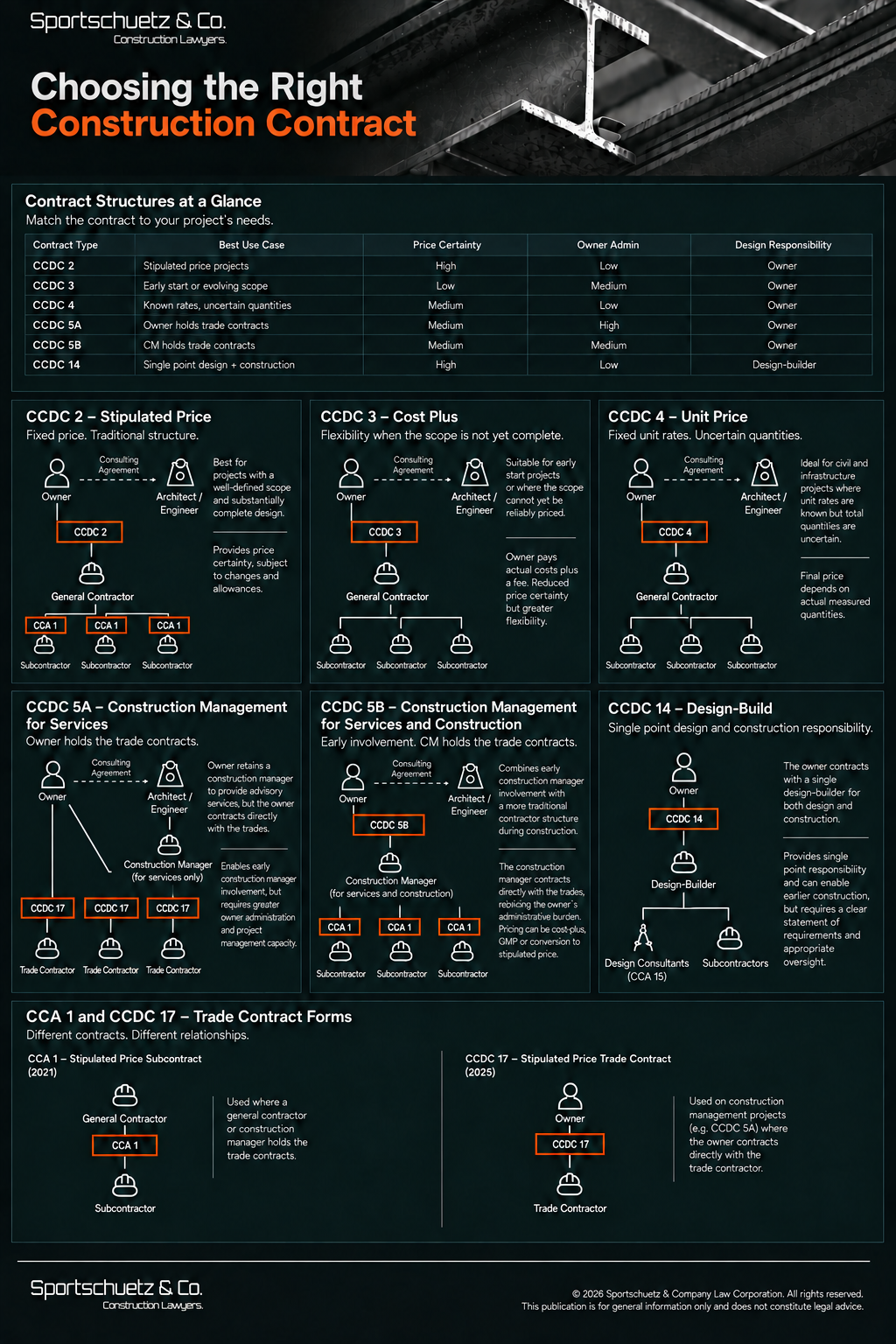
There is no single contract structure that is appropriate for every construction project. A relatively complete design and clearly defined scope may lend itself to a stipulated price contract. A project that must commence while the design is still developing may be better suited to construction management or cost-plus contracting. Civil and infrastructure work with predictable rates but uncertain quantities may favour unit pricing. Design-build can provide a single point of responsibility where the owner is prepared to transfer both design and construction obligations to one contracting party.
What Should Owners Consider Before Selecting a Contract?
Our team of construction lawyers generally considers four key issues particularly important when evaluating a construction procurement and delivery model.
First is pricing certainty. An owner should determine how much price certainty is realistically available at the time the construction contract will be awarded. A fixed price is most meaningful where the design, specifications and scope of work are sufficiently developed to allow contractors to price the work accurately. Attempting to impose a fixed price too early can cause contractors to price contingencies and uncertainty into their bids or result in significant change claims once construction begins.
Second is design responsibility. The owner must decide whether it wants to retain its own architect or engineer and remain directly responsible for the design relationship, or whether responsibility for design and construction should be combined under a design-builder.
Third is project administration. Some structures require the owner to hold and administer multiple contracts, which can result in a significant administrative burden on an owner. For an unsophisticated owner constructing their first or one of their first projects, remaining detached from direct trade contractor administrative burdens is often the preferred procurement method. Alternatively, and to reduce management burden, many owners place most trade contracting and coordination responsibility on a general contractor, construction manager or design-builder.
Finally, timing matters. If construction must begin before the design is complete, a traditional design-bid-build model (i.e., CCDC 2 or CCDC 4 agreements) may not provide the flexibility required. Construction management, cost-plus and design-build structures can permit earlier contractor involvement and phased construction.
CCDC 2: Stipulated Price Contract
The CCDC 2 Stipulated Price Contract remains one of the most familiar construction contracts in Canada and is often acknowledged as the standard prime contract between an owner and contractor for a single predetermined fixed or lump-sum price.
Under this traditional procurement structure, the owner retains its architect or engineer under a separate consulting agreement. Once the design is sufficiently complete, contractors bid on the project and the successful general contractor enters into the CCDC 2 contract directly with the owner. The general contractor then contracts separately with its subcontractors and suppliers, commonly by way of CCA 1 stipulated-price subcontracts.
This traditional stipulated-price procurement model is the origin of the term “design-bid-build”, as distinguished from “design-build”. Under a design-build model, the owner retains a general contractor who assumes responsibility for both the design and construction of the project, with the design developed to achieve the owner’s pre-determined project outcomes and performance requirements.
The principal advantage of the CCDC 2 stipulated-price procurement model is price certainty. Provided the scope and design are exceedingly well-defined, the owner knows the stipulated contract price before construction begins, subject to changes, allowances and other adjustments permitted by the contract.
Such price certainty may also be misleading where documents are incomplete or the design is insufficiently developed. Missing details, design coordination issues, unforeseen conditions and owner-directed changes can substantially increase ultimate project costs. Owners should therefore resist the temptation to tender prematurely merely to obtain what appears to be a fixed price. We therefore often assist owners with their development of interior design specifications since such interior fixtures and finishes are often overlooked and can result in significant pricing uncertainty within a stipulated-price procurement model.
A CCDC 2 stipulated-price contract is often appropriate where the design (including interior design) is substantially complete, the scope is reasonably predictable, sufficient time exists to complete design before construction, and the owner is comfortable maintaining a separate contractual relationship with its consultant.
CCDC 3: Cost Plus Contract
The CCDC 3 is a standard-form cost-plus prime contract between an owner and contractor. The contractor is reimbursed for defined costs of the work together with an agreed percentage or fixed fee applied to such cost basis.
Cost-plus contracting can be useful where work must commence before the design or scope is sufficiently developed to obtain reliable stipulated pricing. Instead of requiring the contractor to price substantial uncertainty at the beginning of the project, the owner pays the actual allowable cost of performing the work. For example, commencing demolition and bulk excavation prior to finalizing all specifications and scopes of work for a project can be effectively executed using a cost-plus procurement model.
Conversely, a trade-off to cost-plus procurement is reduced price certainty. Because the owner ultimately bears much of the cost risk, the definition of the Cost of the Work becomes extremely important. The agreement should clearly address labour costs (especially in respect of internal T4 labour), equipment, subcontractor costs, insurance, supervision, general conditions, overhead, contractor fees and other reimbursable expenses. Owners should also consider meaningful reporting requirements, open-book accounting, audit rights, procurement procedures and approval thresholds.
To overcome cost uncertainty, a cost-plus contract may be combined with a guaranteed maximum price where appropriate (“GMP”). A GMP can provide a measure of cost protection, but it should not be treated as equivalent to a conventional stipulated price. The GMP must be read together with its assumptions, allowances, contingencies, exclusions and adjustment provisions. We also note that very few general contractors are willing to enter into a cost-plus agreement with a GMP.
The CCDC 3 contract can be particularly useful where the design remains incomplete, renovation or existing-condition risks make pricing difficult, an accelerated construction start is required, or the parties value flexibility more than early price certainty.
CCDC 4: Unit Price Contract
The CCDC 4 is the standard-form prime contract between an owner and contractor where the contractor agrees to fixed prices for specified units of work and the final contract price depends on the actual quantities performed.
Unit price contracting is particularly useful where the nature and scope of the work is understood but the precise quantities cannot reliably be established before construction commences. For example, excavation, earthworks, roadwork, civil servicing and similar work may involve measurable units where the parties can agree to a rate before the actual quantity is known. The Ministry of Transportation and Infrastructure, for example, often relies on unit-price contracts due to the nature of work being undertaken, although the CCDC 4 form of agreement is not generally used by government entities.
The main risk underlying unit-rate contracts is the quantity of work being completed rather than the respective unit prices. This systemic risk makes measurement provisions particularly important. The contract should clearly identify the applicable unit, how quantities will be measured, who is responsible for measurement and verification, and what happens if actual quantities vary materially from tendered estimates.
Parties should also consider whether significant changes in quantity should trigger adjustments to the agreed unit price. A contractor pricing 1,000 units may have materially different mobilization, equipment and overhead economics if it is ultimately required to perform 100 units or 5,000 units. Our construction lawyers often revise the CCDC 4 by way of supplementary conditions to ensure that client contractors are protected in the event of the wholesale deletion or material reduction of major scopes of work.
The CCDC 4 contract is generally most effective where individual units of work can be clearly defined and measured, reliable unit rates can be established, but total quantities remain uncertain.
CCDC 5A: Construction Management for Services
The CCDC 5A is a materially different contractual structure compared with traditional contracting models and is a relatively new construct in the construction industry. Under a CCDC 5A, the owner retains a construction manager to provide construction management services, but the construction manager does not itself hold the trade contracts. CCDC describes the construction manager as acting as a limited agent of the owner while administering and overseeing contracts entered into directly between the owner and trade contractors. In light of above, this procurement method is often referred to as the “owner-at-risk” model because the project owner enters into multiple trade contracts itself, rather than offloading such counterparty risk to a construction manager.
Under an owner-at-risk construction management procurement model, the owner ordinarily maintains a separate agreement with its architect or engineer, a CCDC 5A agreement with the construction manager, and separate contracts with the individual trade contractors. The CCDC 17 Stipulated Price Contract between Owner and Trade Contractor is specifically designed for this need.
One of the principal benefits of the CCDC 5A structure is early involvement of a qualified construction manager. The construction manager can participate during design, provide constructability advice, clash detection services, assist with budgeting, going to market to seek bids from qualified trade contractors, develop tender packages and permit portions of the work to be tendered and constructed before the entire design is complete.
The disadvantage is increased owner risk and administration. Because the owner contracts directly with each trade contractor, the owner has multiple contractual relationships and greater exposure to trade coordination, payment, builders lien holdback administration risks, default and interface issues. Of particular concern is the need to reconcile scope gaps and overlaps among the various trade contractors, which is an exceedingly difficult task to get right. While the construction manager administers the trade contractor relationships on behalf of the project owner, it does not replace the owner as a contracting party and does not assume the contractual risk of a trade contractor’s failure to perform its obligations under a trade contract. Accordingly, the owner remains directly exposed to the consequences of trade contractor default, including the cost and delay associated with procuring replacement performance and resolving disputes between trades. The CCDC 5A is therefore generally better suited to highly sophisticated owners with internal project-management capacity or experienced external advisors.
CCDC 5B: Construction Management for Services and Construction
The CCDC 5B combines many of the benefits of early construction management involvement with a more traditional design-bid-build general contractor procurement model.
The CCDC 5B is an agreement between the owner and construction manager under which the construction manager provides advisory services during pre-construction and performs and manages the work during construction. CCDC states that the work initially proceeds on an actual-cost basis plus a percentage or fixed fee, with options including a GMP, a GMP with shared cost savings, or conversion to a stipulated price (while many believe the stipulated-price conversion option mirrors exactly the terms and conditions of a CCDC 2 contract, that is in fact not the case and extreme caution should be practiced when undertaking such conversion).
Unlike a CCDC 5A, the construction manager contracts directly with trade contractors (usually by way of CCA 1 Stipulated Price Subcontracts). Under the CCDC 5B, the construction manager assumes a role much closer to that of a traditional general contractor and takes direct contractual responsibility for trades. This difference is fundamental and is also why this procurement model is often referred to as the “construction-manager-at-risk" model. The contractual relationship between the construction manager and all trades greatly reduces the owner's administration burden and provides a clearer contractual chain between the construction manager and its subcontractors.
The CCDC 5B can also permit the construction manager to become involved before the design is complete, assist with estimating and constructability analysis, tender early packages and begin construction in phases.
The pricing provisions set out in the CCDC 5B deserve particular attention. Cost-plus arrangements, contingency, allowances, GMP adjustments, savings provisions, procurement requirements and conversion to stipulated price can materially affect final allocation of financial risk.
A CCDC 5B contract is often attractive for larger or more complex projects where the owner wants early contractor involvement and phased construction but does not want the direct trade-contract burden associated with a CCDC 5A contract.
CCDC 14: Design-Build Contract
Design-build fundamentally changes the traditional relationship between owner, consultant and contractor. The current CCDC 14-2026 is a traditional design-build prime contract under which the owner contracts with a single design-builder to perform both design services and construction for a predetermined stipulated price. Rather than retaining the primary design consultant directly, the owner contracts with a qualified design-builder. The design-builder then retains the architect, engineer or other design consultants.
The primary advantage to an owner under a design-build procurement model is single-point responsibility. If design and construction problems arise, the owner is less exposed to the traditional argument that the contractor blames the consultant while the consultant attributes the problem to the quality of construction. The design-builder is contractually responsible to the owner for both functions.
The model can also facilitate earlier construction and greater contractor input during design. However, the owner gives up some of the independence that exists when its architect or engineer contracts directly with the owner. For that reason, owners frequently retain an independent owner's advisor to assist with preparing performance requirements, reviewing design submissions and monitoring compliance by the design-builder.
The quality of the Owner's Statement of Requirements is of utmost importance. Design-build does not eliminate the need for a well-defined project scope. Rather, this procurement model changes the way the project requirements are expressed. The owner must clearly identify the required performance, quality, functionality and other project criteria so that the design-builder understands what it is required to deliver.
A CCDC 14 contract is generally best suited to owners who want single-point design and construction responsibility, can clearly define the required project outcomes, and are comfortable allowing the design-builder greater control over how those outcomes are achieved.
CCA 1 and CCDC 17: Understanding the Trade Contract Relationship
The appropriate trade contract depends on the project delivery structure. The CCA 1 is a stipulated price subcontract between a prime contractor and subcontractor. It is commonly used where a general contractor or construction manager is responsible to enter into downstream trade contracts.
The CCDC 17 contract is materially different from the CCA 1 subcontract. The CCDC 17 contract is specifically intended for construction management projects where the owner contracts directly with the trade contractor. We note that the CCDC 17 is used only in conjunction with a CCDC 5A contract, and not with a CCDC 5B contract.
The above distinction matters considerably when addressing payment, changes, delay claims, defaults, insurance, lien rights and dispute resolution. A project may look similar operationally because the construction manager is coordinating the trades on site, but the underlying legal structure is very different depending on whether the construction manager or the owner entered into trade contracts.
Standard Forms Are Only the Starting Point
Selecting the correct CCDC or CCA form of contract is only the first step for project participants. Standard industry forms are deliberately drafted as balanced documents intended for broad use across Canada. They do not automatically address commercial or legal issues arising on particular projects. Due to copyright restrictions, amendments to these standard-form agreements must be made through supplementary conditions, which allow the parties to tailor the contract to the specific counterparty and project risks, commercial arrangements and requirements of the project.
Among other matters, parties should consider payment procedures, changes and change directives, notice requirements, schedule obligations, delay and extension-of-time provisions, liquidated damages, insurance, indemnification, limitation of liability, hazardous materials, testing, site conditions, termination rights, dispute resolution and project-specific allocation of design responsibility.
For projects in British Columbia, the contract must also operate within the realms of the Builders Lien Act and other applicable provincial legislation. BC's Construction Prompt Payment Act has now been enacted but is not yet in force, making it particularly important that future projects are reviewed as the implementation regime develops.
We tell all of our clients that the outcome of a successful procurement analysis should not be to select the contract with the lowest apparent price or greatest theoretical transfer of risk. The goal should rather be to select a structure that matches design maturity, project complexity, schedule, owner's capabilities and commercial realities of the particular project. A contract structure that properly reflects those conditions at the outset can significantly reduce disputes once construction begins.