British Columbia Prompt Payment
British Columbia is moving toward a significant change in how construction projects are invoiced, paid and, perhaps most importantly, how payment disputes are resolved while a project is ongoing.
The Construction Prompt Payment Act received Royal Assent on 27 November 2025. However, the legislation is not yet in force. Its operative provisions, together with related amendments to the Builders Lien Act and StrataPropertyAct, will come into force by regulation. As of September 2026, the Province continues to work through regulations and implementation frameworks.
The stated objective is straightforward and difficult to criticize. Contractors and subcontractors should not be required to finance construction projects because payment is delayed for months while invoices work their way through layers of approval. Prompt payment legislation attempts to address this problem by imposing statutory payment deadlines and giving parties access to expedited adjudication when payment disputes arise.
The Basic Prompt Payment Framework
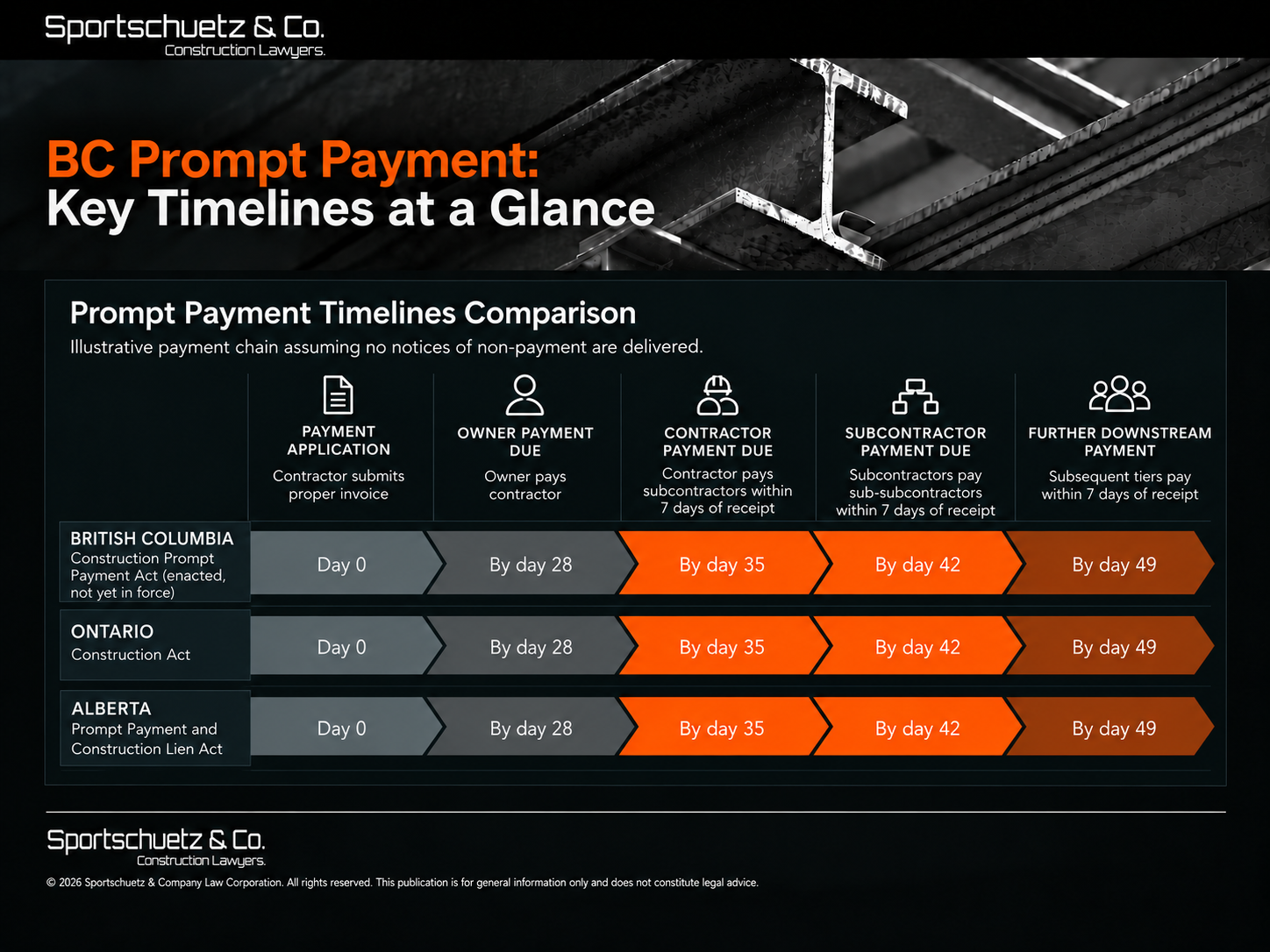
Under the new legislation, once a contractor delivers a “proper invoice”, an owner will generally be required to pay the amount owing within 28 calendar days. Parties further down the contractual chain will generally be required to make payment within 7 calendar days after receiving payment, subject to statutory deadlines that continue down the construction pyramid.
A proper invoice will need to contain prescribed information, including identification of the contract, the applicable billing period or milestone, a description of the services or materials supplied and the amount claimed.
Importantly, an owner will have only 7 calendar days to advise that an invoice does not qualify as a proper invoice. If the owner does not do so, the invoice is deemed proper. Further, a contract cannot make the submission of a proper invoice conditional upon prior certification by a payment certifier or approval by the owner, although certification, testing and commissioning can still occur after the invoice is submitted.
If an owner disputes payment, a notice of non-payment must generally be delivered within 14 calendar days after the invoice date and must identify both the amount not being paid and the reasons for non-payment.
The legislation also addresses the familiar situation where a contractor does not pay a subcontractor because the contractor itself has not been paid by the owner. Where non-payment is based on upstream non-payment, the contractor must provide the applicable notice of non-payment and undertake to refer the upstream dispute to adjudication within 21 calendar days.
These provisions should create substantially greater discipline around payment administration. Owners and contractors will no longer have the luxury of allowing invoices to remain unresolved for extended periods while discussions continue informally.
Interim Adjudication
The more significant change may be the introduction of statutory interim adjudication. The Act permits a party to refer a range of disputes to adjudication, including whether an invoice is proper, failure to make payment, valuation of services or materials, notices of non-payment and whether payment is required under a contract. Significantly, the legislation expressly contemplates disputes concerning change orders, including unapproved and proposed change orders.
The process is deliberately fast. Once appointed, the adjudicator is given broad authority to control the procedure, ascertain facts and law, draw inferences, conduct site inspections and obtain expert assistance where appropriate. The party commencing the adjudication must provide its supporting records within 5 days after the adjudicator accepts the appointment. Unless properly extended, the adjudicator must issue a written determination within 30 calendar days after receiving those records.
If the adjudicator directs payment, the amount must generally be paid within 15 calendar days. Failure to pay may permit the successful party to suspend further work and recover reasonable costs arising from the suspension and subsequent resumption of work. A determination can also be filed with the Supreme Court and enforced as though it were a judgment.
Prompt Payment Unlikely to be a Panacea
There is little doubt that statutory payment deadlines can improve cash flow and discourage the practice of simply delaying payment. The experience in Ontario and Alberta, however, suggests that the adjudication component should be approached with some caution.
Ontario has now accumulated several years of experience with statutory adjudication. The process is increasingly being used. In ODACC’s 2025 fiscal year, 324 adjudications were commenced and 143 determinations were rendered. The increasing use of adjudication suggests that parties are becoming more comfortable with the process. It also demonstrates that construction disputes have not disappeared simply because prompt payment legislation exists.
The speed of the process can itself create challenges. Construction disputes are often document-heavy and factually complicated. Change order claims can involve scope, notice provisions, pricing, scheduling, delay, causation and hundreds or thousands of project records. Requiring parties to assemble and argue those disputes within a matter of weeks does not necessarily make the underlying dispute simple.
Ontario's experience also suggests that statutory timelines should not automatically be equated with instantaneous dispute resolution. Reported 2025 data indicates that only approximately 61% of determinations were issued within the standard 30-day period.
Alberta provides another caution. Adjudication use continues to grow, but uptake remains relatively modest. ARCANA reported administering 50 payment dispute cases during its 2025-2026 reporting period. There is also a practical question of proportionality. Alberta's adjudication authority specifically cautions that smaller claims may face adjudication fees beginning at approximately $3,000, before considering legal costs and possible enforcement expenses.
In other words, expedited adjudication may be extremely useful in the right case, particularly where a significant payment dispute threatens cash flow or continuation of the work. It may be less attractive where the amount in dispute is relatively small or where the factual and contractual issues are exceptionally complicated.
There is also a broader commercial concern. Introducing formal adjudication while the parties are attempting to complete a project together may solve an immediate payment dispute, but it can also harden positions and increase legal involvement during construction. A 30-day adjudication does not necessarily preserve the commercial relationship in the manner that a negotiated resolution or mediation might.
Appealing an Adjudicator’s Decision
The legislation recognizes that expedited adjudication is an interim process. An adjudicator's determination will be binding immediately, but it is not necessarily the final determination of the parties' contractual rights. The same dispute may ultimately be determined by a court or through arbitration, at which point the adjudicator's determination can be displaced. The parties can also subsequently resolve the dispute by written agreement.
There is also a limited right to seek judicial review within 35 days after the determination is issued. This should not be described as a conventional appeal on the merits. Under the legislation, a determination may be set aside on judicial review only on limited grounds, including that the dispute was not properly subject to adjudication, the adjudicator lacked jurisdiction or the adjudicator failed to observe procedural fairness.
This distinction will be important. A party that simply believes the adjudicator reached the wrong conclusion on the evidence will not necessarily be entitled to have that decision immediately overturned. Payment may therefore be required on an interim basis even though the underlying dispute remains capable of being litigated or arbitrated later.
Changes to the Builders Lien Act
The legislation will also make several important amendments to the British Columbia Builders Lien Act. Most notably, the statutory holdback period will be reduced from 55 days to 46 days. The underlying lien filing period itself is not being shortened.
The amendments will also abolish what are commonly known as Shimco liens. The Builders Lien Act will expressly provide that a person does not have a lien against the required holdback itself, reversing the standalone lien against holdback recognized following Shimco Metal Erectors Ltd. v. Design Steel Constructors Ltd.
Finally, the definition of an “improvement” will be amended to expressly include demolition and removal work.
Some Final Thoughts
The most immediate upshot for owners, contractors and subcontractors is that project administration will become increasingly important and time-consuming. The new legislation places considerable weight on proper invoices, notices and short statutory deadlines. Parties that wait weeks to review invoices, document deficiencies, price changes or respond to contractual claims may find themselves at a significant disadvantage.
Prompt payment should improve cash flow and create greater payment certainty within the British Columbia construction industry. Those are worthwhile objectives. But experience elsewhere suggests it should not be viewed as a cure for construction disputes themselves. For contractors, subcontractors and owners alike, clear and concisely drafted contracts, careful project documentation, timely notices and sensible commercial resolution of disputes will remain every bit as important under the new regime as they are today.